Powered by philanthropy and Hoag’s privademic model, top researchers Rajan Gogna, PhD, and Esha Madan, PhD, are pioneering early detection tools to transform the fight against hard-to-treat cancers.
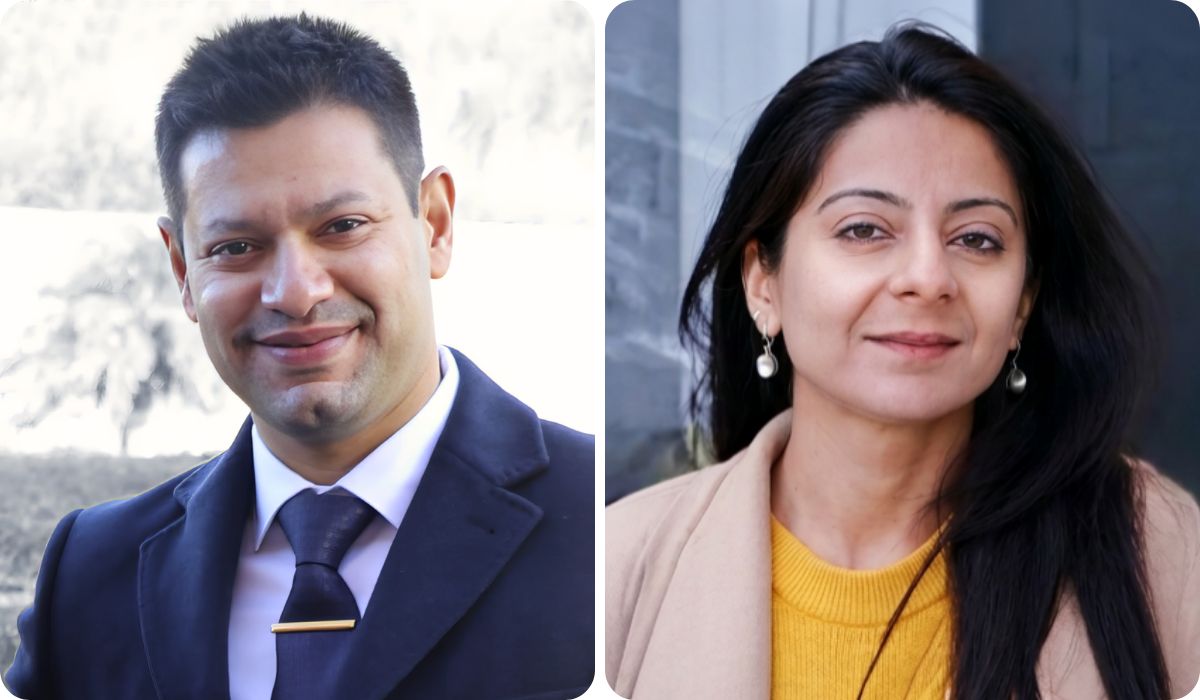
Rajan Gogna, PhD, and Esha Madan, PhD, Hoag Family Cancer Institute
Leaving behind established academic careers in the United States and Europe, Rajan Gogna, PhD, and Esha Madan, PhD, recently joined the Hoag Family Cancer Institute with a conviction that surprised many of their university colleagues: they believed they could accomplish more at Hoag than within a traditional academic medical center.
It was a decision rooted in possibility.
“What I saw was a beautifully run organization,” Dr. Gogna said. “You put top-quality research on top of that, and the sky is the limit.”
That vision is becoming reality.
As Hoag continues to expand its clinical and translational research enterprise, the Translational Research Laboratory is entering an exciting new chapter, bringing together nationally recognized physicians and scientists, advanced technologies, and philanthropic investment to accelerate the translation of laboratory discoveries into patient care.
Hoag’s unique privademic model combines the scientific rigor of an academic medical center with the agility, efficiency, and patient-centered focus of a private health system. For researchers, that means fewer barriers between scientific discovery and clinical application. The ability to move quickly was one of the defining reasons Drs. Gogna and Madan chose Hoag for the next chapter of their careers.
Changing How We Think About Cancer
The research led by Drs. Gogna and Madan challenges one of oncology’s most fundamental assumptions.
Rather than focusing exclusively on how tumors grow, they also investigate how cancers interact with, and ultimately overtake, the healthy cells surrounding them.
That shift in perspective has profound implications.
Instead of asking only how to destroy cancer cells, their research asks a different question: How can we prevent cancer from successfully invading the organs and tissues upon which it ultimately depends?
The answers could reshape the future of cancer care.
Their work addresses some of medicine’s most difficult cancers, including ovarian and pancreatic cancers, by examining cancer not only as uncontrolled tumor growth, but also as a competitive process in which malignant cells progressively weaken, displace, and eliminate the healthy cells that normally protect an organ.
Among their most promising advances is research into blood-based biological signals that arise from the earliest interactions between ovarian cancer cells and the surrounding tissue microenvironment. This work may create opportunities to identify high-risk or early disease substantially sooner than is possible using current diagnostic approaches, opening a broader window for monitoring and intervention.
In parallel, the team is developing therapeutic strategies designed to protect healthy tissues from being weakened or eliminated by a tumor, making it more difficult for cancer to establish itself, spread to distant organs, or return after surgery and treatment. This host-protective strategy is being developed particularly for metastatic and recurrent ovarian and pancreatic cancers and is intended to complement established anticancer therapies.
“By the time many ovarian and pancreatic cancers are detected, they have already spread or carry a substantial risk of recurrence,” Madan said. “Our goal is to identify these diseases earlier while also protecting the healthy tissues that cancer must overcome in order to progress.”
Building Something Bigger
For Steven Grossman, MD, PhD, Grace E. Hoag Executive Medical Director Endowed Chair, Hoag Family Cancer Institute, recruiting investigators such as Gogna and Madan reflects Hoag’s years of intentional investment in building a collaborative research ecosystem.
The growing Translational Research Laboratory brings together complementary approaches to solving some of cancer’s greatest challenges, from biomarker discovery and precision medicine to novel therapeutics and advanced laboratory models.
“We’re attacking the same problems from different angles,” Grossman said. “That’s where the strength comes from.”
This collaborative environment allows physicians and scientists to work side by side—identifying clinical challenges, testing new ideas, and moving promising discoveries toward patient care more quickly than is often possible in traditional academic settings.
Philanthropy Makes It Possible
The remarkable growth of Hoag’s translational research enterprise—from a new laboratory launched just a few years ago to a multidisciplinary team of 14 scientists and research professionals—has been made possible through the shared commitment of philanthropists who believe the future of cancer care begins with discovery.
That momentum began in 2023, when Hoag Innovators, a community of philanthropists, entrepreneurs, and business leaders dedicated to accelerating healthcare innovation at Hoag, provided the early investment to launch the Translational Research Laboratory. Their support helped establish the infrastructure needed to begin building a collaborative research environment capable of translating promising scientific discoveries into better care for patients.
Today, that vision continues to grow.
As Circle 1000, Hoag’s volunteer-led philanthropic organization that has supported cancer care since 1987, approaches its 40th anniversary, members have committed this year’s fundraising efforts to expanding the Translational Research Laboratory. Their ongoing support continues to strengthen Hoag’s research and recruitment capabilities alongside the Hoag Family Cancer Institute’s other leading priorities.
The laboratory’s long-term future was further strengthened by funding from the Clemons Family Clinical and Translational Research Endowment, one of the largest investments in research in Hoag’s history. The $13.45 million endowment, established earlier this year, was designed to support clinical and translational research across the organization by providing flexible, enduring resources to expand research and pursue the most promising discoveries across Hoag’s institutes. Initial funding from the gift is helping support the laboratory’s current expansion, including the recruitment of Drs. Rajan Gogna and Esha Madan.
Together, these community investments are creating the kind of research ecosystem that attracts world-class scientists, fosters collaboration between the laboratory and the cancer center, and accelerates discoveries with the potential to transform patient care.
For Dr. Gogna, that opportunity comes with an equally profound responsibility.
“People place their trust in us,” he said. “Our responsibility is to honor that trust by asking the right questions, pursuing meaningful discoveries, and making the very best use of their generosity.”
For Dr. Grossman, that partnership between philanthropy and science is what makes Hoag uniquely positioned to lead the next generation of cancer research.
“Every major breakthrough begins with someone willing to invest in what's possible,” he said. “Our responsibility is to turn that belief into better care for patients.”
As Hoag continues to grow its research enterprise, philanthropy remains the catalyst that transforms bold ideas into meaningful advances for patients—as quickly, rigorously, and thoughtfully as possible.